Showing posts with label MEANINGful Monday. Show all posts

Monday, January 17, 2011

MEANINGful Monday


Inverted Box Pleat Draperies on Rings. A more tailored looking alternative to a pinch pleated drape. A box pleat is a flat double pleat that is formed by evenly folding under the fabric on either side of the pleat. This forms a loop on the face of the fabric that is then flattened against the face of the fabric, making a “box” shape, and sewn into place.


Photo Credit: February 2011 House Beautiful, Interior Design by Erin Martin.

Monday, January 10, 2011

MEANINGful Monday

Hepplewhite. Name for an 18th Century English design style made popular by cabinetmaker George Hepplewhite. The Hepplewhite Style is most easily identified by the elegant "Shield" chair back. Another popular version of a Hepplewhite chair is this beautiful "Heart" back chair featured here:


Photo Credit: February 2011 House Beautiful, Interior Design by Gideon Mendelson

Monday, December 20, 2010

MEANINGful Monday: Hearth


Hearth:
The floor of a fireplace, which usually extends into a room and is commonly paved with brick or clad in stone, tile or concrete. {Canadian House and Home}

Monday, December 13, 2010

MEANINGful Monday: Newel Post


Newel post:
The large post at the beginning, at a turn, or at the end of a stair railing which the horizontal handrail and vertical balusters are attached to for stability.

And in keeping with the holiday season, I thought I'd share where I first learned what a newel post was - from my favorite family man, Clark W. Griswold!


This is my favorite holiday movie. My husband and I watch it three times a season - first on Thanksgiving to signify the start of Christmas, once mid-December with some hot spiked cider, and always with my Dad on Christmas day. Hope you're enjoying your family traditions like we are!


Monday, November 29, 2010

MEANINGful Monday: Muntin


Muntin:
A strip of wood or metal separating and holding small panes of glass (lights or lites), which can be found in doors, windows and furniture.  Muntins may also be referred to as glazing bars, muntin bars, or sash bars.  {Tommy Smythe, black muntins}

Monday, November 22, 2010

MEANINGful Monday: Stretcher

Stretcher: 
A stabilizing rail that runs horizontally between vertical furniture legs. Found on tables, chairs or sofas, stretchers come in various styles including circumferential, double and turned spindle. May also be referred to as a stretcher beam. {Lee Industries sofa}

Monday, November 15, 2010

MEANINGful Monday: Marquetry


Marquetry:
A technique used for covering surfaces (furniture, flooring, etc) with varying shapes, sizes and types of veneer to create organic patterns, designs or pictures. Pieces of veneer are adhered side-by-side to the substructure, not inlaid in it. Similar to parquetry. {Late 17th century, William & Mary period marquetry bureau}

Monday, November 8, 2010

MEANINGful Monday: Grisaille


Grisaille:
Wall or art paintings executed entirely in a monochrome or near-monochrome palette, usually in shades of grey. A grisaille may also be created as an underpainting for an oil painting (in preparation for layers of color over it), or as a model for an engraver to work from. {A bedroom with grisaille wall by White House designer Michael Smith, a grisaille painting by James Gleeson}

Monday, November 1, 2010

MEANINGful Monday: Bergere


Bergere:
A French armchair in which the sides, seat and back are completely ENCLOSED with caning or upholstery with an exposed wood frame. It was first designed during the Louis XV era in the early 18th century. Not to be confused with the French fauteuil. {Suzani print bergere chair via Stylehive}

Monday, October 25, 2010

MEANINGful Monday: Fauteuil


Fauteuil:

A French OPEN-ARMED salon chair with an upholstered, or caned, back originating in the mid 18th century. Not to be confused with the French bergere. {Green velvet fauteuil}

Monday, October 18, 2010

MEANINGful Monday: French Ivory


French Ivory:
A synthetic ivory made of plastic that was created by the British Xylonite Company in 1866. Also referred to as Celluloid, Ivoride, Ivorine, Ivorite and Pyralin. {Martha's French Ivory collection}

Monday, October 11, 2010

MEANINGful Monday: Cabriole Leg

Cabriole leg:
An elongated S-shaped furniture leg first made popular in late 18th century Europe, where the upper arc is convex (bows outward) and the lower is concave (bows inward). {Bernhardt Martha Stewart cabriole leg settee}

Monday, October 4, 2010

MEANINGful Monday: What-Not


What-Not:
An English piece of furniture inspired by, and very similar to, the French étagère which was popular during the 19th century. It typically consists of slender uprights supporting multiple open shelves and was commonly used to display small decorative objects. {19th century English bamboo corner what-not with japanning, 19th century English mahogany what-not}

Monday, September 27, 2010

MEANINGful Monday: Burl

Burl:
An abnormal growth on a tree commonly found in the form of a rounded outgrowth on a tree trunk or branch that is filled with small knots from dormant buds. Burls yield a very decorative and highly grained wood, and are valued by artisans for their beauty and rarity. Also known as burs, or burrs, in the UK. {1970's Milo Baughman burled olivewood, marble & chrome buffet}


Monday, September 20, 2010

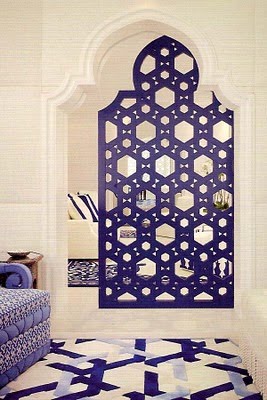
MEANINGful Monday: Fretwork


Fretwork:
An ornamental cut out grid or lattice used to decorate furniture, architecural details and musical instruments. While fretwork is most commonly geometric in design, it can also be created using intricate and intertwined patterns.  {Designer Geoffrey Bradfield's Moroccan-inspired pocket door with fretwork}

Monday, September 13, 2010

MEANINGful Monday: Shagreen


Shagreen:
A decorative leather made from the hide of a shark or stingray.  As a very durable yet exotic material, it was commonly used during the 17th and 18th century to cover small decorative objects such as books or clocks.  It is typically dyed green and has a surface of rounded protrusions. {English shagreen and silvered bronze humped back clock, circa 1895}

Monday, August 30, 2010

MEANINGful Monday: Aubusson

Aubusson:
Refers to tapestries or carpets from Aubusson in central France (also refers to textiles in the style of genuine Aubussons). Their origins date back to the 14th century and are distinguished by elaborate patterns and a pileless weave.

Aubusson rugs’ history is rich and a significant part of the revival of the arts of the Renaissance period. They were hand woven flat weave wool rugs and tapestries originally based on Turkish designs. In 1665 and thereafter, Aubusson rug designs were based on the motifs of Savonnerie rugs. Prior to this time, Savonnerie rugs were only available to the King, with design and production overseen by the artists and weavers of the royal courts. With Aubusson rug designs mimicking those of Savonnerie rugs, they became available to anyone who could afford them, typically the upper class and sophisticated aristocracy of Europe.  {Aubusson ottoman image via House Beautiful, aubusson rug image via Country Living}

Monday, August 23, 2010

MEANINGful Monday: Klismos


Klismos:
A classical Greek chair which features saber legs, of which the front legs curve forwards and the back legs curve back. The chair rail has a concave shape. {Image via 1st Dibs}

Monday, August 16, 2010

MEANINGful Monday: Boiserie

Boiserie:
A French term used to define ornately carved wood room panelling used on walls, doors, shelves, and mural or mirror frames. Boiseries were fashionable in 17th and 18th century France. Examples may be painted, unpainted or partially gilded. {L'Hotel Gaulin, circa 1785}

Monday, August 9, 2010

MEANINGful Monday: Ormolu

There are so so soooo many terms out there to properly classify furniture styles and pieces, and architectural details and construction. I've sometimes felt like describing antiques requires that I learn a whole new language!

This brings us to our new blog series - MEANINGful Monday!

Every Monday we are going to post a new term, one photo example, and a quick definition of its meaning. It's going to be fun and educational - using correct terms with antique dealers and trades people can take you a long way!

Ormolu: 
Metal alloy or gilded metal manufactured to resemble gold applied as decorative ornamentation to furniture and other fine antiques; often develops a brassy patina as it ages.

Linked Within

Related Posts with Thumbnails